Beyond the Milk Mustache: 10 Calcium Facts That Will Surprise You
If you grew up hearing “Got Milk?” ads, you might think the most important calcium facts begin and end with strong bones. For decades, we’ve been trained to associate this mineral exclusively with a tall glass of dairy and the promise of skeletal steel. While it is true that 99% of your body’s calcium resides in your bones and teeth to provide structural support, that remaining 1% is arguably doing the more immediate, life-sustaining work.
Think of calcium less as just a building block and more as your body’s “manager mineral.” It is a biological multitasker that acts as an electric switch for your nervous system, a key which unlocks every muscle contraction, and a critical component in your blood’s ability to clot. Obtaining it isn’t just about drinking milk; it’s about fueling the complex chemical reactions that keep you alive every second.
The Body Electric: Calcium’s Secret Jobs (Facts 1-4)
While we obsess over bone density, the most critical “calcium facts” are often the ones happening invisibly in your blood and soft tissues right now.
1. The 1% Rule: Why Your Body “Steals” from Your Bones
Here is the harsh truth: your body cares more about keeping you alive today than keeping your bones strong tomorrow. About 99% of your calcium is stored in your skeleton, acting as a massive bank vault. The remaining 1% circulates in your blood and is non-negotiable for survival. If your dietary intake drops, your body doesn’t just “make do”; it triggers the parathyroid hormone (PTH) to dissolve your bone tissue and release calcium back into the bloodstream to maintain that critical 1% balance.
2. It’s the Body’s “On” Switch
Your nervous system is essentially powered by calcium. It isn’t just about structure; it is about communication. When a nerve impulse reaches the end of a neuron, it triggers an influx of calcium ions into the cell. This sudden surge forces tiny vesicles packed with neurotransmitters to fuse with the cell membrane and release their chemical messages. Without this specific calcium action, your brain could not send signals to the rest of your body.
3. It Makes You Move
Every time you blink, type, or walk, you are using calcium. Skeletal muscle contraction relies on a process called the “sliding filament theory.” Inside your muscle fibers, proteins are locked in a relaxed state by a “guard” protein called troponin. Calcium is the key that unlocks this guard. When released, calcium binds to troponin, moving it aside so your muscle fibers can grab onto each other and pull.
As soon as the calcium is pumped away, the muscle relaxes. This cycle happens millions of times a day, including in your heart muscle, where calcium regulates the rhythm of your beat.
4. The Clotting Commander
If you cut your finger, calcium saves you from bleeding out. In the medical world, calcium is actually known as Clotting Factor IV. It is an essential ingredient in the coagulation cascade—a series of chemical dominoes that results in a scab. Without sufficient calcium availability in the blood, the enzymes required to form a stable fibrin clot simply cannot function, turning minor injuries into major threats.
Busting Dietary Myths (Facts 5-7)
We often assume that if we eat a food containing calcium, our body uses all of it. Unfortunately, digestion isn’t that simple. These calcium facts reveal why what you eat matters just as much as how you eat it.
5. The “Green” Calcium: Bioavailability Matters
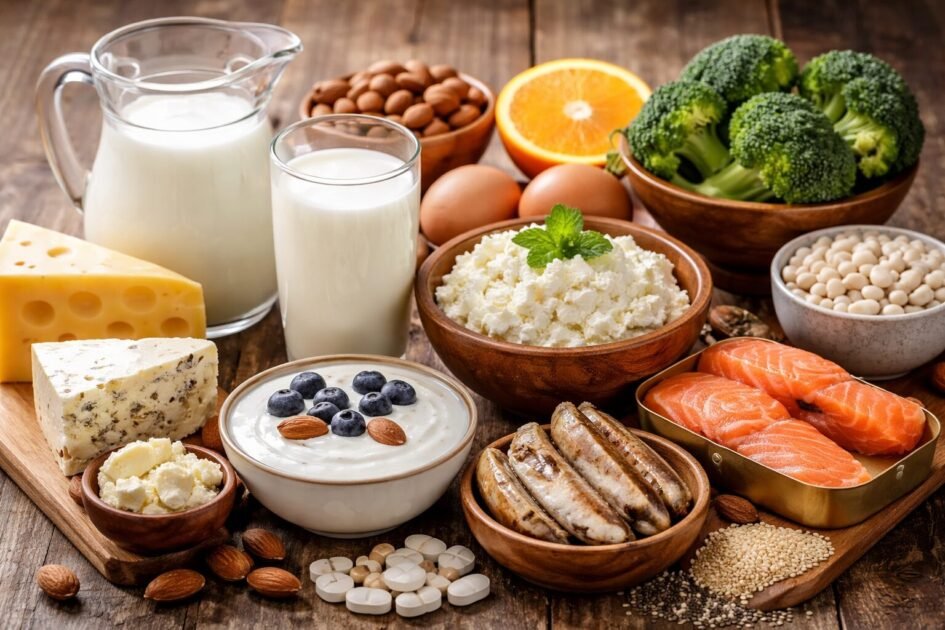
While dairy is the poster child for calcium, you can get significant amounts from plant sources—but there is a catch. It comes down to bioavailability: the amount of the nutrient your body can actually absorb. For instance, while spinach contains plenty of calcium, it is also high in oxalates, which bind to the mineral and block absorption (you only absorb about 5% of the calcium in spinach). Conversely, low-oxalate greens like kale, bok choy, and broccoli allow for much higher absorption rates. Additionally, “bone-in” fish like sardines are nutritional powerhouses, offering more calcium per serving than many dairy products.
6. The Vitamin D Gatekeeper
You could consume the perfect amount of calcium every day and still be deficient if you lack Vitamin D. Think of Vitamin D as the doorman to your bloodstream. Without it, the “door” in your intestines remains locked, and calcium simply passes through your system unabsorbed. Vitamin D regulates the active transport of calcium across the gut lining. This is why milk is often fortified with Vitamin D—nature requires them to work as a team.
7. The Kidney Stone Paradox
A common fear is that eating too much calcium causes kidney stones (which are often made of calcium-oxalate). However, the opposite is often true for dietary calcium. When you eat calcium-rich foods, the calcium binds with oxalates in your stomach and intestines before they can reach your kidneys. This prevents the stone-forming crystals from developing. Harvard Health notes that getting calcium from food can actually protect against stones, whereas high-dose calcium supplements taken without food might increase the risk.
Long-Term Health & Aging (Facts 8-10)
As we age, the role of calcium shifts from “construction” to “maintenance.” These final calcium facts highlight how the mineral influences your longevity, mood, and cardiovascular health in ways you might not expect.
8. The Age Limit: Your “Bone Bank” Closes at 30
One of the most sobering biological realities is that you do not build bone forever. Most people reach their peak bone mass between the ages of 25 and 30. After this window closes, you can no longer significantly increase the density of your skeleton; you can only maintain what you have. Think of your bones like a retirement account: you deposit heavily in your youth, and after age 30, you are living off the interest. If your “savings” are low when you hit 30, you are at a much higher risk for osteoporosis later in life.
9. The PMS Connection
Calcium might be a natural remedy for premenstrual syndrome. Research indicates that calcium levels fluctuate during the menstrual cycle, and deficiencies may exacerbate symptoms like mood swings, bloating, and cramping. Several studies suggest that consistent calcium intake can help stabilize these fluctuations. In fact, some clinical trials have shown that calcium supplementation significantly reduces the severity of PMS symptoms compared to a placebo, linking the mineral directly to hormonal regulation and mood stability.
10. The “Calcium Paradox”
It seems contradictory, but it is possible to have calcium-deficient bones and calcium-clogged arteries simultaneously. This phenomenon is known as the Calcium Paradox. The missing link is often Vitamin K2. While Vitamin D helps you absorb calcium, Vitamin K2 acts as the traffic controller, directing that calcium into the bones and away from the soft tissues (like arteries). Without sufficient K2, calcium can deposit in your blood vessels, contributing to plaque buildup and heart disease rather than strengthening your skeleton.
10 Calcium Facts That Will Surprise You – Conclusion
It is time to look beyond the milk mustache. While strong bones are the most visible result of adequate calcium intake, they are really just the storage facility for a mineral that powers the very essence of your life. From the electric spark of a thought to the rhythmic beat of your heart, calcium is the unsung hero of your body’s daily operations.
The takeaway isn’t to obsessively count milligrams or rely heavily on supplements, but to embrace a diverse, nutrient-rich diet. By prioritizing “food first”—incorporating a mix of dairy, leafy greens, nuts, and fish—and ensuring you get enough Vitamin D and K2, you can keep your body’s electrical system running smoothly for decades to come.
For more information check out our article on How calcium benefits the body.
Frequently Asked Questions (FAQ)
Q: Is it better to get calcium from food or supplements?
A: Experts almost universally recommend getting calcium from food first. Food sources provide better bioavailability and come packaged with other essential nutrients. High-dose calcium supplements have been linked to potential risks, such as kidney stones and heart issues (the "Calcium Paradox" mentioned in Fact #10). Always consult your doctor before starting a supplement regimen.
Q: I’m vegan/lactose intolerant. Can I still get enough calcium?
A: Absolutely. You don't need a cow to get calcium. Fortified plant milks (almond, soy, oat) often have just as much calcium as dairy milk. Tofu (specifically calcium-set tofu), chia seeds, almonds, and low-oxalate greens like collard greens and bok choy are excellent sources.
Q: What are the silent signs that I might be calcium deficient?
A: Early calcium deficiency (hypocalcemia) often has no symptoms. However, as it progresses, you might experience muscle cramps (especially in the back and legs), numbness or tingling in the fingers and toes, brittle nails, or confusion. Long-term deficiency usually reveals itself through osteopenia or osteoporosis, often discovered only after a bone fracture.