Beyond the Skeleton: 5 Critical Benefits of Calcium You Didn’t Know About
Let’s discuss 5 benefits of calcium you probably didn’t know about. If you grew up seeing “Got Milk?” ads or being told to finish your yogurt so you would grow big and strong, you already know the headline about calcium: it builds bones. It is the mineral celebrity of the skeletal system, and for good reason.
It is true that roughly 99% of the body’s calcium is stored in our bones and teeth, providing the hard structure that keeps us upright. However, that remaining 1% is where the real magic happens.
While the calcium in your skeleton is like money in a savings account—sitting there for long-term stability—the calcium circulating in your blood and soft tissues is like the cash in your wallet. It is being spent every single second to keep you alive. This tiny fraction is so critical to your immediate survival that if your dietary intake drops, your body will actively leach calcium from your bones to maintain the levels needed in your blood.
Why is the body so desperate to protect that 1%? Because without it, your heart wouldn’t beat, your nerves wouldn’t fire, and your blood wouldn’t clot.
According to the Harvard T.H. Chan School of Public Health, calcium is a “whole-body” nutrient that acts as a biological key, unlocking functions that are essential for life. Today, we are looking past the skeleton to explore the five essential, life-sustaining functions of calcium that have nothing to do with your bones.
Calcium Benefit 1: Powering Muscle Contraction
While we often associate protein with muscles, it is actually calcium that flips the switch to make them move. Whether you are sprinting for a bus or simply blinking your eyes, calcium is the biological spark plug that makes it happen.
The “Sliding Filament” Mechanism
To understand this, we have to look inside a muscle fiber. Your muscles are made of two main filaments: actin (thin) and myosin (thick). In a resting state, these two strands want to connect and slide past each other to create a contraction, but they are blocked by a protein barrier called tropomyosin.
This is where calcium enters the scene. When your brain sends a signal to a muscle to move, calcium ions flood into the muscle cells. They bind to a specific regulatory protein called troponin. This binding changes the shape of the troponin, which physically pulls the tropomyosin barrier out of the way.
Once the barrier is removed, the myosin can grab onto the actin—like a climber grabbing a rope—and pull. This action shortens the muscle fiber, resulting in a contraction.
Why It Matters
Without adequate calcium, this “unlocking” process cannot happen smoothly. This is why one of the first physical signs of severe calcium deficiency (hypocalcemia) is often muscle cramps, spasms, or even tetany (involuntary contraction). Conversely, while calcium helps muscles contract, magnesium is often needed to help them relax again, making the balance between these two minerals critical for athletes and active individuals.
Calcium Benefit 2: Orchestrating Nerve Transmission
If muscles are the engine, nerves are the wiring. However, the electrical signal zooming down your nerve fibers hits a physical dead end when it reaches the gap between two cells (the synapse). It needs a way to bridge that gap to keep the message moving. That bridge is built by and is one of the benefits of calcium.
The Critical “Spark”
Nerves communicate using chemical messengers called neurotransmitters (like serotonin or dopamine), which are stored in tiny bubbles called vesicles at the end of the nerve cell. They wait there, locked and loaded, until calcium gives the order.
When an electrical impulse reaches the end of a nerve, it triggers “voltage-gated calcium channels” to open. Calcium ions rush inside the cell, acting as the immediate trigger that forces the vesicles to fuse with the outer membrane and release their chemical payload to the next cell. This process is known as exocytosis.
Why It Matters
According to Neuroscience (2nd edition), this dependency is absolute: “lowering the concentration of Ca2+… blocks transmission.”
Without this calcium influx, the signal stops dead. Your brain could command your finger to move, but the message would never arrive. This is why a common early symptom of calcium deficiency is paresthesia—that sensation of numbness or tingling in the fingers and toes. It is essentially your nervous system misfiring because the mineral concentration required to transmit signals is off-balance.
Calcium Benefit 3: Regulating Heart Rhythm and Blood Pressure
While calcium helps your biceps contract when you lift a weight, its role in your heart is even more specialized. Your heart is a muscle, but unlike your skeletal muscles, it needs to beat automatically and rhythmically, 24/7, without you thinking about it. That’s why this is one of the benefits of calcium.
The Pacemaker of the Heart
In the heart’s natural pacemaker cells (the Sinoatrial or SA node), calcium is responsible for the actual electrical spike that triggers a heartbeat. In most nerve cells, sodium starts the electrical signal, but in the heart’s pacemaker cells, calcium is the primary driver of the “action potential.”
This means calcium literally keeps the beat. If calcium levels in the blood become too high (hypercalcemia) or too low (hypocalcemia), it can lead to dangerous arrhythmias (irregular heartbeats) because the electrical timing gets thrown off.
Controlling Blood Pressure (Vascular Tone)
Calcium also works on the smooth muscles that line your blood vessels. When calcium enters these cells, it causes the vessels to tighten (constrict), which raises blood pressure. When calcium flows out, the vessels relax (dilate), lowering blood pressure and is on our list of the benefits of calcium.
This mechanism is so powerful that it is the basis for a common class of medication known as Calcium Channel Blockers. As the Mayo Clinic explains, these drugs work by preventing calcium from entering the cells of your heart and arteries. By blocking the calcium, the vessels relax and open up, allowing blood pressure to drop.
It’s a perfect example of how the body uses calcium to fine-tune the “plumbing” of your circulatory system minute by minute.
Calcium Benefit 4: Enabling Blood Clotting (Coagulation)
When you get a paper cut, your body immediately goes to work to plug the leak. Most people credit platelets (the sticky cells) or Vitamin K for this miracle, but neither can finish the job without calcium. So blood clotting is on the list of the benefits of calcium.
The “Factor IV” Connection
In the medical world, the process of clotting is called the “coagulation cascade”—a complex domino effect of different proteins activating one another. These proteins are numbered (Factor I, Factor II, etc.). Calcium is so vital to this chain that it is officially designated as Clotting Factor IV.
Calcium acts as a bridge. It helps clotting enzymes bind to the surface of platelets (phospholipids). Without calcium anchoring them, these enzymes float uselessly, and the chemical reaction cannot proceed.
From Liquid to Solid
Specifically, calcium is required for the conversion of prothrombin into thrombin. Thrombin is the enzyme that ultimately transforms liquid fibrinogen into solid fibrin strands—the “mesh” that catches blood cells to form a stable scab.
This dependency is so absolute that blood banks utilize it to keep donated blood from clotting in the bag. As noted in clinical guides from the National Center for Biotechnology Information (NCBI), anticoagulants like citrate are added to blood bags specifically to bind with the calcium. By “locking up” the calcium, they pause the clotting ability entirely until the blood is transfused into a patient.
Why It Matters
Even if you have plenty of platelets, a severe lack of ionized calcium in the blood means the clotting cascade breaks, potentially leading to excessive bleeding from minor injuries.
Calcium Benefit 5: Cellular Signaling and Enzyme Activation
On a microscopic level, calcium acts as the body’s “universal messenger.” While hormones and neurotransmitters carry messages between cells, calcium is often responsible for carrying that message inside the cell to make sure the job actually gets done.
The “Second Messenger” System
In biology, this is known as being a second messenger. Imagine a hormone (like adrenaline) is a mail carrier knocking on the front door of your cell. The mail carrier never actually enters the house. Instead, the knock triggers the release of calcium ions inside the cell. These calcium ions act as the person inside who hears the knock, picks up the mail, and runs it to the kitchen to be read.
When calcium levels rise inside a cell, it triggers a chain reaction of biological events, telling the cell to divide, move, or die (apoptosis). As detailed in a review on calcium signaling mechanisms, this signaling pathway is crucial for almost every cell type in the human body, from fertilization at the very beginning of life to the immune response fighting off infections.
Activating Digestive Enzymes
Calcium is also a mandatory co-factor for several key enzymes, particularly those responsible for digestion. For example, pancreatic lipase—the enzyme responsible for breaking down dietary fats—requires calcium to maintain its structure and function. Without calcium stabilizing the enzyme, your body cannot effectively break down and absorb the fats from your food.
Why It Matters
Without calcium acting as a signaling molecule, your cells would be “deaf” to many of the body’s hormonal commands. Hormones could knock on the door all day, but without calcium to deliver the message inside, the cell wouldn’t react.
Best Non-Dairy Sources
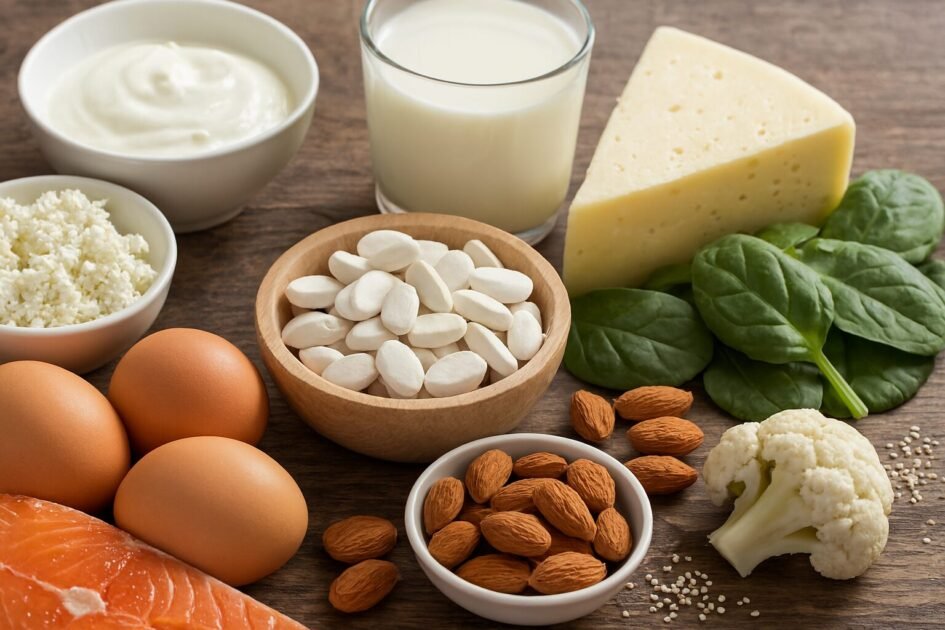
Since most people already know that milk and yogurt are calcium powerhouses, it is important to highlight that you don’t need dairy to hit your daily recommended targets. Whether you are vegan, lactose intolerant, or just don’t like milk, the earth provides plenty of alternatives.
However, not all plant calcium is created equal. You want to focus on foods with high bioavailability, meaning your body can actually absorb the mineral effectively.
Dark Leafy Greens: This is the gold standard for plant-based calcium. Collard greens, turnip greens, and kale are excellent choices. (Note: While spinach contains calcium, it is also high in oxalates, which can block absorption. As the Harvard T.H. Chan School of Public Health notes, low-oxalate greens like bok choy and kale are generally better sources for absorption than spinach.)
Canned Fish: If you eat fish, sardines and canned salmon are incredible sources—but only if you eat the bones (which are soft and edible in canned varieties).
Fortified Foods: Many modern staples are fortified to match dairy levels. Look for calcium-fortified tofu, orange juice, and plant milks (almond, soy, oat). (Tip: Always shake the carton of plant milk before pouring, as the calcium can settle at the bottom.)
Nuts & Seeds: Chia seeds, almonds, and sesame seeds pack a surprising punch of calcium in a small serving.
For a comprehensive list of calcium content in various foods, check the USDA FoodData Central or the NIH Calcium Fact Sheet.
Conclusion
It is time to rebrand calcium. It isn’t just “the bone builder”—it is the “life sustainer.”
While 99% of your calcium is indeed providing the structural scaffolding for your body, the remaining 1% is working overtime. From the electrical spark that beats your heart to the chemical signal that allows you to think, calcium is involved in almost every moment of your existence.
To recap, beyond your bones, calcium is essential for:
Powering every muscle contraction in your body.
Bridging the gap between your nerves to send signals.
Regulating your heart rhythm and blood pressure.
Enabling your blood to clot after an injury.
Acting as a messenger inside your cells to activate enzymes.
So, the next time you look at a glass of milk or a plate of collard greens, remember: you aren’t just eating for strong bones in the future; you are eating to keep your heart beating right now.
Disclaimer: This article is for informational purposes only and does not constitute medical advice. If you are concerned about your calcium levels, consult with a healthcare professional before adding supplements to your routine.
Frequently Asked Questions (FAQ)
Q: Can I just take a supplement instead of changing my diet?
A: While supplements are helpful for some, getting calcium from food is generally preferred by nutritionists. Food sources provide better bioavailability and come packaged with other nutrients. Furthermore, some studies suggest that high-dose calcium supplements may be linked to a higher risk of kidney stones or heart issues, whereas dietary calcium is not. Always talk to your healthcare provider before starting a supplement regimen.
Q: What helps the body absorb calcium?
A: You can eat all the calcium in the world, but it won't work without Vitamin D. Vitamin D is like the "doorman" that opens the intestine to let calcium into the bloodstream. Magnesium is also crucial, as it helps convert Vitamin D into its active form so it can do its job.
Q: Can you have too much calcium?
A: Yes. A condition called hypercalcemia occurs when calcium levels in the blood are too high. This can weaken your bones (because the calcium is being leached out), create kidney stones, and interfere with how your heart and brain work. This is rarely caused by food alone and is more commonly associated with over-supplementation or underlying medical conditions (like hyperparathyroidism).
Q: Does caffeine affect calcium absorption?
A: Yes, caffeine can slightly interfere with calcium absorption and increase the amount of calcium you excrete in urine. However, for most people with a balanced diet, drinking a cup or two of coffee a day has a negligible effect on overall calcium levels.